English
 简体中文



What vital wheat gluten is, and what it can and cannot fix
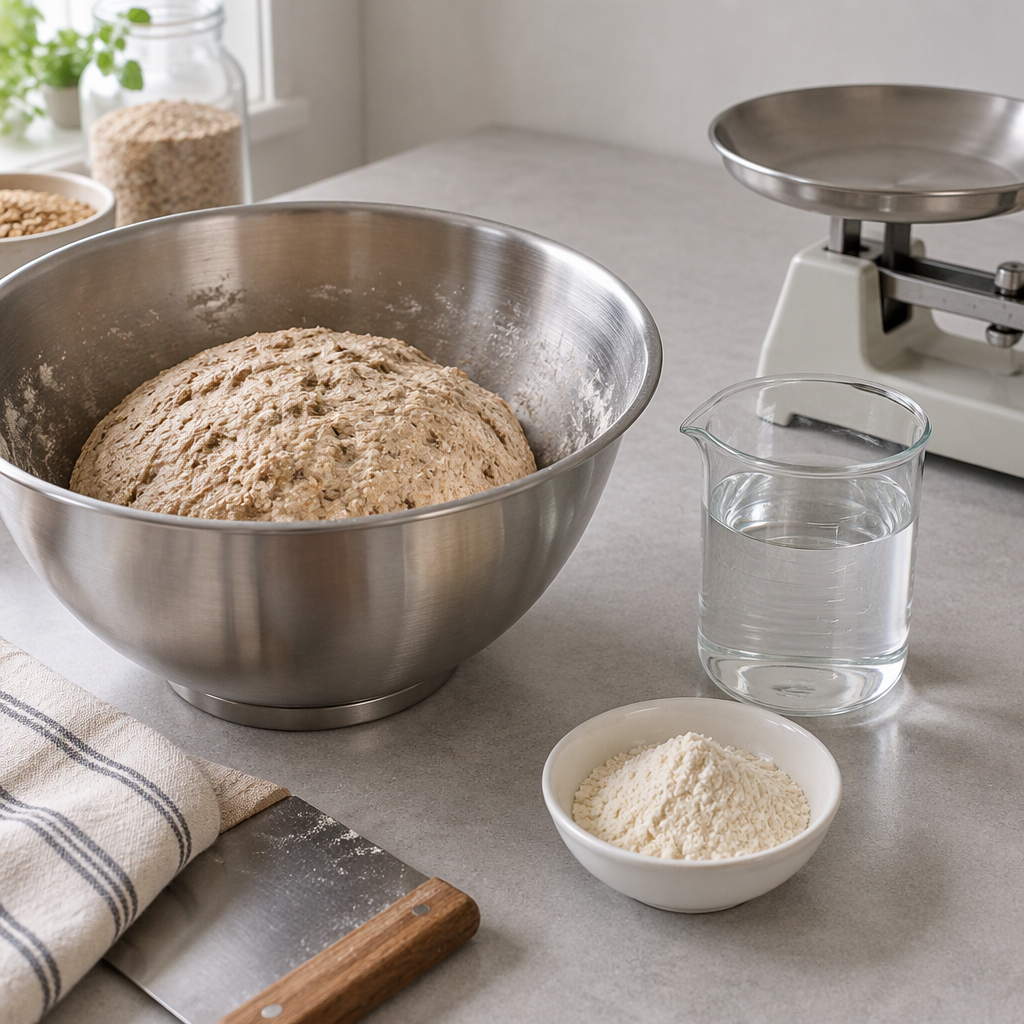
Vital wheat gluten is the dried form of freshly extracted wheat protein that regains its intrinsic functionality once it is rehydrated, usually supplied as a cream-to-tan powder. US regulation defines wheat gluten, including vital gluten as dried gluten that has retained its elastic properties, and lists it as generally recognized as safe for functions such as dough strengthening, with no limitation other than current good manufacturing practice. It adds protein and strength to the network. What it cannot do is replace the bran and germ that whole-grain flour deliberately keeps, so it will not make 100% whole wheat dough behave like white-flour dough.
21 CFR 184.1322 defines wheat gluten — including vital gluten as dried gluten that has retained its elastic properties — and lists dough strengthening among its permitted functions, while the Whole Grains Council definition of a whole grain sets out the bran, germ and endosperm composition that makes whole-grain dough behave differently at the mixer. For comparison when you read a specification, an industry summary of compositional reference values for wheat protein gives a minimum of 80.0% protein on a dry basis (N × 6.25), with maximum 10.0% moisture, 2.0% fat, 2.0% ash and 1.5% fibre.
Two limits matter before you change a formula. The US regulation sets no numeric ceiling for wheat gluten, and a missing maximum is not a recommended use level: the level you choose has to come out of your own bakes. Second, vital wheat gluten works on the protein side of the formula only. It does not restore bran or germ, and it cannot compensate for a flour lot milled to a very different particle size.
Step 1: Record a baseline bake before you change water or gluten
Bake your current whole-grain formula at least twice before adding anything, using one flour lot and one mixing procedure, and record the water weight, the mix time, the dough temperature, the proof time and a measured loaf result. Published trials on whole wheat bread treat vital wheat gluten as an addition expressed against flour weight — one 2020 study in the Journal of Food Science used 2.5% of flour weight — and that reference point only means something if your baseline is weighed the same way.
- Flour: mill, lot code, and any particle-size or ash specification printed on the bag.
- Water: weighed, not jugged, with the water temperature noted.
- Mixing: mixer model, speed settings and the total time to the same development point.
- Dough: final dough temperature and a one-line note on how it feels at the end of the mix.
- Fermentation and proof: times, temperatures and the height the dough reaches before baking.
- Result: loaf weight, a measured height or volume, a crumb photograph and a short tasting note.
Step 2: Pick a starting vital wheat gluten level you can defend
Set a three-point bracket instead of hunting for one correct level: test one point below, one at and one above a published reference, and handle water by the same procedure every time. A 2020 whole wheat bread study added vital wheat gluten as a separate treatment at 2.5% of flour weight, which is a defensible anchor for the middle of a bracket, not a recommended dosage for your formula. The table below gives first brackets by formula situation; they are trial points, not specifications.
| Formula situation | First bracket to test (% of flour weight) | Decide the bracket with |
|---|---|---|
| 100% whole wheat pan bread, coarse flour | 2.0 / 2.5 / 3.0, the middle point matching the published 2020 trial level | Proof time, crumb firmness and side-wall strength |
| Blended flour with 50–70% whole grain | 1.0 / 2.0 / 3.0 | Whether the crumb opens and the loaf keeps its height |
| Lean hearth dough at high hydration | 2.0 / 2.5 / 3.0 | Extensibility against shape retention at the moulder |
A bracket is a test design, not a specification, and a higher addition is not automatically better — past a point the dough tightens without the crumb improving. Whole wheat flour particle size varies between mills and lots, so a level that holds on one delivery has to be re-checked on the next before it goes into a written formula.
Step 3: Re-balance water at the mixer after the gluten goes in
Expect the water the dough takes to change once vital wheat gluten is in the formula, because the added protein has to rehydrate before it regains its functionality — but how much extra water your dough needs is a property of your flour, your formula and your mixer, so measure it rather than assuming it. Hold back part of the formula water and add it in weighed increments at the mixer, noting the point where the dough stops taking more.
- Weigh the full formula water and set a portion aside — enough to make two or three separate additions.
- Mix with the reduced water until the flour is just hydrated. Before you reach into the bowl to scrape or feel the dough, switch off and unplug the mixer, or follow the manufacturer's lockout/tagout procedure, and confirm the agitator has come to a complete stop.
- Add the held-back water in two or three weighed increments, mixing briefly between each, and record the increment at which the dough turns noticeably slack and sticky.
- Return the dough to full development on the same speed and time as your baseline, so the comparison stays fair.
- Record total water as a percentage of flour weight, and repeat the identical procedure for every gluten level in the bracket.
More water will not repair a weak network. If the dough takes water and still sags at the moulder or collapses in proof, the driver is strength or fermentation rather than hydration, and adding further water usually makes handling worse. Change one variable at a time, and before any manual check of the dough, switch off and unplug the mixer, or follow the manufacturer's lockout/tagout procedure, and confirm the agitator has stopped.
Step 4: Separate under-hydration from weak gluten by when the fault appears
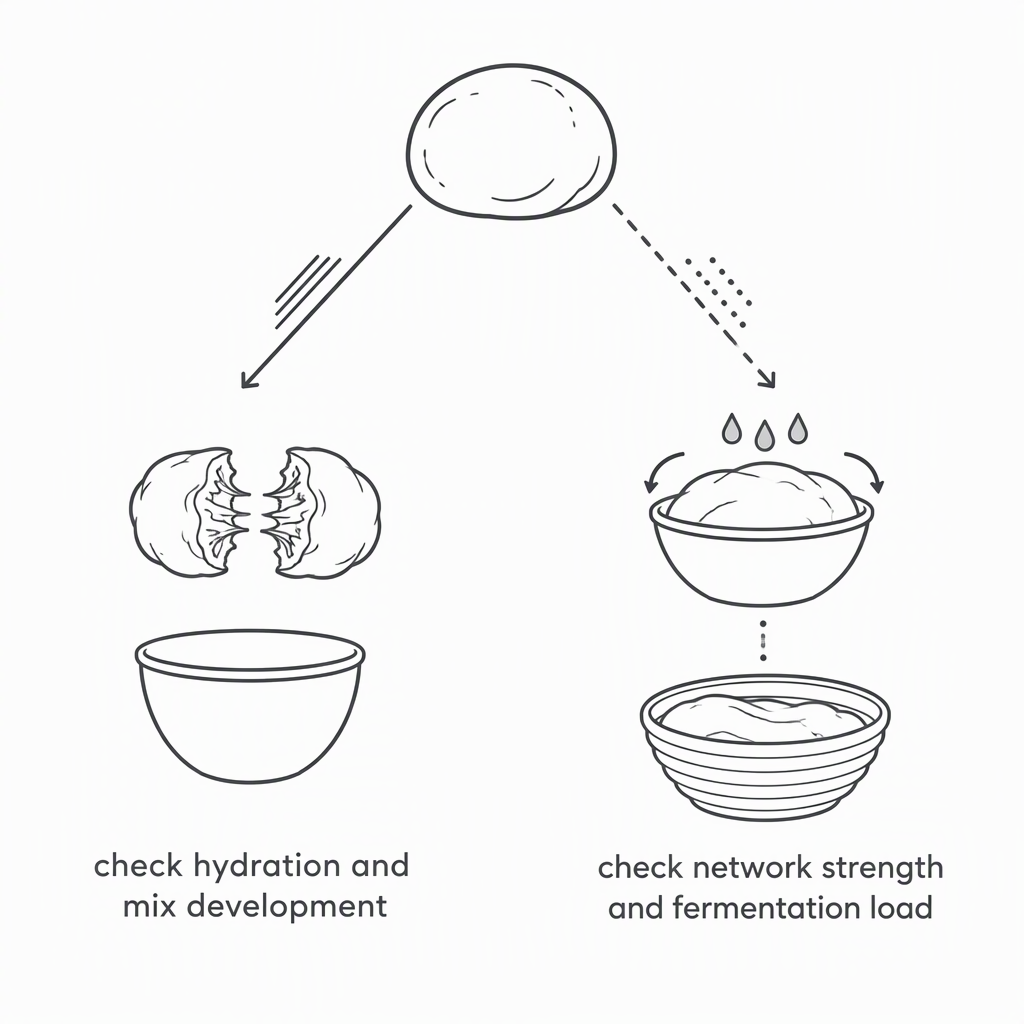
Use timing to tell the two faults apart. If the dough feels tight and tears early, before it has had time to hydrate and develop, suspect the water or the mix. If it hydrates, mixes out cleanly and then loses shape late — at the moulder or during proof — suspect network strength and fermentation load instead. Published work attributes whole wheat bread quality problems to reduced gluten functionality and to flour particle size differences, which is why both faults can appear in the same dough.
| What you see at the mixer and bench | What it usually points to | What to check first |
|---|---|---|
| Tight, dull dough that tears early in the mix | Water not yet available to the flour, or the mix is not developed | Water weight against the baseline, and total mix time |
| Hydrates and mixes out cleanly, then sags in proof or collapses | Network strength or fermentation load | Where the level sits on the gluten bracket, plus proof time and temperature |
| Sticky and slack, never tightens with further mixing | Water beyond what the formula holds, or over-mixing | The held-back water procedure and the mixer speed |
| Good shape at the moulder, weak oven spring | Fermentation and proof rather than hydration | Proof time and dough temperature |
Step 5: Verify the balance across runs and flour lots before writing a specification
Run the chosen water and gluten combination at least three times on production equipment, across at least two flour lots, before it goes into a specification. Whole wheat flour particle size differs between lots, so a balance that held once in the development kitchen is a hypothesis, not yet a setting.
- Three consecutive production runs with the same recorded water, gluten level and mix profile.
- Two or more flour lots, each result tagged with its lot code and mill specification.
- One measured outcome used every time — loaf height, volume by displacement or scaled weight — never a verbal impression.
- Dough temperature and proof conditions logged, because both move the result independently of the formula.
- A short crumb and eating note per run, so a change that adds height but dries the crumb still shows up.
- A written working range for water and gluten level, set to the tolerance your line can actually hold.
What to confirm with a vital wheat gluten supplier before you scale
Ask for the documents that let you compare one delivery with the next: a specification and a certificate of analysis stating protein on a dry basis (N × 6.25), moisture, fat, ash and fibre, the method those figures reference, and the physical form you are buying. 冠县瑞昌贸易有限公司 supplies vital wheat gluten in both powder and pellet form and lists bakery products among its application areas — but any grade still has to be trialled in your own formula before it enters a specification.
- Certificate of analysis per lot, with protein reported on a dry basis and the test method named.
- Which edition of the compositional standard the specification cites, and whether that edition is current.
- Physical form — milled powder or pellet — and how it behaves in your dosing and dispersion step.
- Allergen statement and the labelling wording your destination market requires.
- Packaging, storage conditions and the shelf life the supplier will commit to in writing.
- A production-scale sample for a trial bake before the first commercial order.
Regulatory status does not travel automatically between markets. The US position is generally recognized as safe for functions including dough strengthening, with no limitation other than current good manufacturing practice, and that position is specific to the United States. Check the additive and labelling rules for every country where the bread will be sold, and treat an association summary of compositional values as a starting point rather than a substitute for the supplier's own certificate.
Conclusion: one balance, verified on your own line
Balance water and strength as a single setting, decided on your own line: a measured baseline, a three-point gluten bracket, water added in weighed increments at the mixer, a failure-mode reading that separates hydration from strength, and three production runs across two flour lots before anything is written down.
The sequence matters more than any single number. A whole-grain formula that feels dry is often short of strength at the same time, and extra water alone will not fix the second problem. Record, bracket, re-balance, read and verify — then let your production data set the specification.
Frequently asked questions on vital wheat gluten, water and dough strength
The questions below cover the points that most often block a decision on the bench: the protein content to expect, whether any legal ceiling applies, whether gluten always means more water, what sifting bran does to a whole-grain claim, what vital wheat gluten cannot do, and which physical form to buy.
What protein content should I expect from vital wheat gluten?
Industry summaries of Codex-based compositional reference values give a minimum of 80.0% protein on a dry basis (N × 6.25), with maximum 10.0% moisture, 2.0% fat, 2.0% ash and 1.5% fibre. Confirm the actual figures on the supplier's certificate of analysis and check which edition of the standard the specification cites.
Is there a legal maximum use level for vital wheat gluten in bread?
In the United States, 21 CFR 184.1322 lists wheat gluten as generally recognized as safe for functions including dough strengthening, with no limitation other than current good manufacturing practice; the section sets no numeric ceiling. Other markets apply their own additive rules, so confirm the position with the relevant authority before a formula is exported.
Does adding vital wheat gluten always mean adding more water?
Not automatically. Vital wheat gluten has to rehydrate before it regains its functionality, so a dough often takes more water once it is added, but how much is formula-specific. Add water in weighed increments and stop when the dough stops taking it; do not use water to compensate for a network that will not hold shape.
Can I sift out the coarse bran instead of adding gluten?
A whole grain contains bran, germ and endosperm in their original proportions, so a sifted flour no longer meets that definition and the whole-grain positioning changes with it. If you want to keep the whole-grain claim, keep the bran and manage water and dough strength instead.
Will vital wheat gluten make 100% whole wheat bread behave like white bread?
No. Vital wheat gluten strengthens the network and adds protein, but it does not remove the bran and germ particles that interrupt that network, nor the variation in whole wheat flour particle size. Expect a different mixing, proofing and handling profile from white-flour dough, and set your targets from your own bakes.
Should I specify gluten powder or gluten pellets?
Choose the form that suits your dosing and dispersion step, then trial it. 冠县瑞昌贸易有限公司 supplies vital wheat gluten in both powder and pellet form. Ask for a sample of the form you intend to buy, run the same bracket you used in development, and compare how it behaves at the mixer before committing to a specification.