English
 简体中文



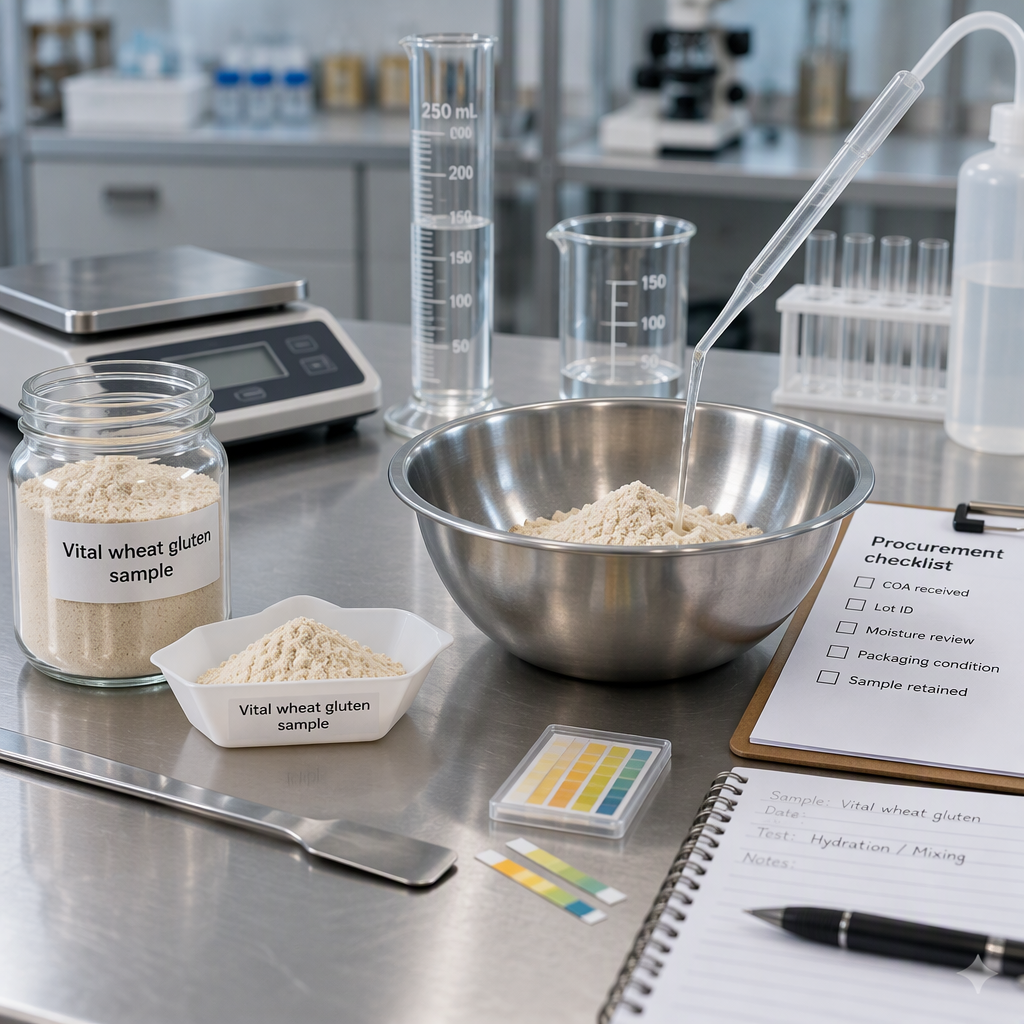
Vital wheat gluten quality testing should not stop at protein percentage; commercial samples can differ in composition and functional behavior even when they are all sold as vital wheat gluten. For procurement approval, ask for test evidence on water-binding or absorption, wet/dry gluten or gluten index where relevant, and a vitality screen that observes mixing behavior, homogeneity, elasticity, and film-forming behavior after water is added.
Why protein content is not enough
Protein percentage is a starting screen, not a complete approval basis, because vital wheat gluten functionality also depends on moisture, ash, starch, lipids, absorption capacity, particle size distribution, gluten protein composition, and other measurable characteristics.
A peer-reviewed article, Fundamental characterization of wheat gluten, describes multi-parameter characterization of 39 commercial vital wheat gluten samples from six suppliers, including compositional, absorption, particle-size, protein-composition, spectroscopic, and statistical clustering work.
Drying conditions matter because heat can devitalize gluten, while mild drying helps preserve the functional properties that become important after rehydration.
For purchasing, this means a high protein value should be paired with functional checks against the buyer’s own application, not treated as proof that a lot will hydrate, mix, stretch, or form films as expected.
Functional tests to request beyond a protein number
Request a functional test package that covers gluten quantity, water interaction, gluten strength or index behavior, and a vitality observation after mixing with water.
| Verification dimension | What it helps screen | Buyer use |
|---|---|---|
| Wet and dry gluten methods | Gluten quantity and recovery behavior | Compare lots against the buyer’s approved internal baseline and declared method. |
| Water-binding capacity | How the material interacts with added water | Check whether hydration behavior supports the target dough or formulated-food system. |
| Gluten index | A strength-related gluten quality dimension | Use it as one comparable laboratory indicator, not as a universal pass/fail number. |
| Farinograph vitality observation for vital wheat gluten | Mixing behavior, homogeneity, elasticity, and film-forming properties after mixing with water | Screen for functional vitality and possible denaturation before large-scale use. |
The Cereals & Grains gluten methods overview lists hand washing, wet and dry gluten, water-binding capacity, gluten index, and a Farinograph test for vital wheat gluten.
How to evaluate water absorption and rehydration behavior
Evaluate hydration as a functional behavior: vital wheat gluten must regain useful properties after water is added, so buyers should compare water interaction under the same method and application conditions used for their approved baseline.
- Ask which water-binding or absorption method is used and keep the method name consistent when comparing suppliers or lots.
- Run rehydration checks before application trials when heat damage or devitalization risk would affect performance.
- Compare the sample with an internally approved reference lot rather than relying on a generic percentage alone.
- Record mixing time, water addition, temperature, and sample preparation conditions in the buyer’s own lab protocol so repeated checks are comparable.
- Escalate any unusual clumping, slow hydration, or inconsistent dispersion to a controlled application trial before releasing the lot for production.
How to check mixing behavior, elasticity, and film formation
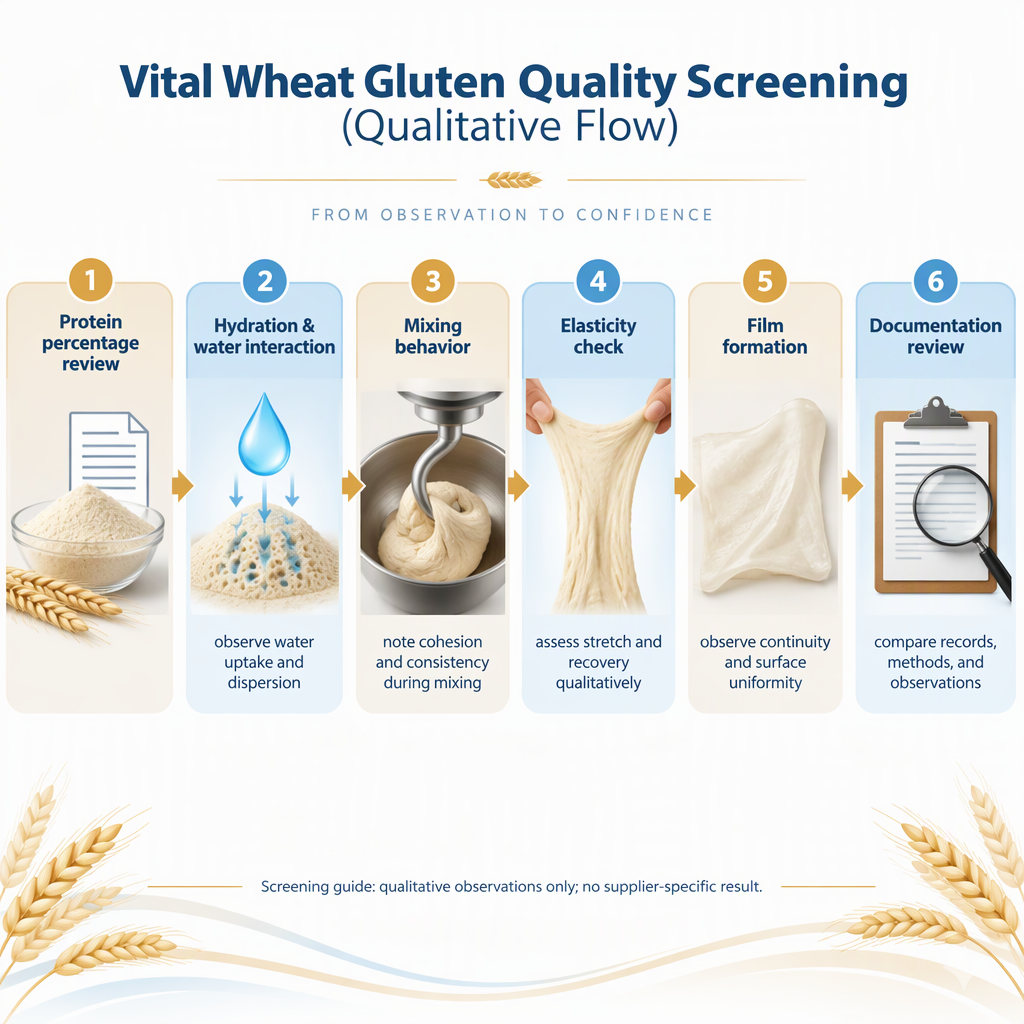
Mixing response, elasticity, homogeneity, and film formation are practical vitality screens because the Cereals & Grains method overview links those observations to whether vital wheat gluten behaves as functional gluten after water addition.
- Prepare the sample using the same declared laboratory method for each comparison lot.
- Observe whether the hydrated material mixes into a homogeneous mass rather than separating or remaining uneven.
- Check elasticity by comparing the hydrated gluten behavior with the buyer’s approved reference sample.
- Look for film-forming behavior after mixing with water, because failure to observe the expected properties can indicate denaturation.
- Document the result with the method, sample code, operator, date, and acceptance decision before supplier approval or lot release.
Gliadins and glutenins influence the viscoelastic gluten network, so a sample that meets a crude protein target can still require further review if its hydrated structure behaves differently from the approved baseline.
What to review when similar protein levels perform differently
When two samples show similar protein levels but different performance, review composition, absorption behavior, particle size, and gluten protein composition before changing suppliers or approving a substitute.
| Observed issue | Review next | Decision use |
|---|---|---|
| Similar protein value, different dough feel | Water absorption capacity and gluten protein composition | Decide whether the difference is acceptable in the target formulation. |
| Different dispersion or hydration speed | Particle size distribution and moisture-related data | Check whether handling and pre-mixing conditions need adjustment or whether the lot should be rejected. |
| Unexpected formulation performance | Ash, starch, lipid, and other compositional indicators | Investigate whether non-protein components may be affecting the application. |
| Weak elasticity or film formation | Viscoelastic network behavior related to gliadins and glutenins | Send the lot to an application trial or supplier technical review before release. |
Build a buyer-side acceptance decision without copying competitor specs
A defensible approval decision should combine agreed test methods, the buyer’s internal baseline, application trials, and supplier documentation; it should not copy an old competitor specification as the buyer’s acceptance standard.
| Decision layer | What to require | How to use it |
|---|---|---|
| Identity and composition | Protein plus relevant composition indicators such as moisture, ash, starch, and lipids | Confirm the material fits the buyer’s ingredient specification scope. |
| Functional lab screen | Water-binding, gluten index, wet/dry gluten, or vitality observations where appropriate | Compare results with the buyer’s approved reference lot and application need. |
| Application confirmation | Rehydration and viscoelastic behavior in the intended product system | Approve, conditionally approve, or reject based on performance in the buyer’s process. |
| Supplier documentation | COA fields, test method names, lot traceability, and change-notification expectations | Make future lot comparisons repeatable and auditable. |
When an official standard, customer contract, or destination-market rule applies, confirm the current edition and any local adoption requirements directly with the responsible authority or customer before writing acceptance limits.
Incoming-lot checklist for vital wheat gluten quality testing
Before accepting a lot, quality engineers should verify documents, method consistency, functional behavior, and application fit against the buyer’s approved baseline.
- Confirm supplier name, lot number, production date or batch identifier, and COA match the purchase order.
- Check protein together with supporting composition indicators rather than relying on protein alone.
- Verify that water-binding, gluten index, wet/dry gluten, or other requested gluten methods are named clearly on the report.
- Review any vitality or mixing observation for homogeneity, elasticity, and film-forming behavior after water addition.
- Investigate weak rehydration, poor elasticity, or film failure as potential functional concerns before release.
- Compare the lot with an approved reference sample and retain records for supplier scorecards and future dispute resolution.
Set standards boundaries before approval
Use published method overviews to choose relevant test dimensions, but set acceptance limits through current official documents, customer requirements, and the buyer’s validated application data.
The Cereals & Grains page supports method selection at an overview level, including the existence and stated scope of several gluten-related methods, but it should not be treated as a complete laboratory procedure or numeric purchasing specification.
For regulated or contract-controlled purchases, ask the supplier and the customer for the current applicable standard, accepted test method, reporting unit, and pass/fail limits before issuing a purchase specification.
Conclusion
The most reliable vital wheat gluten quality testing program combines protein with composition review, absorption behavior, particle-size or structure indicators where needed, and functional performance checks.
- Ask for methods that show water interaction and gluten functionality, not only crude protein.
- Screen mixing behavior, homogeneity, elasticity, and film formation when vitality matters.
- Treat weak rehydration or devitalized behavior as a quality risk for the intended application.
- Build approval limits from current documents, internal baselines, and application trials.
FAQs about vital wheat gluten quality testing
These questions help buyers turn laboratory data into a practical incoming-quality decision.
Is protein content enough to approve vital wheat gluten?
No. Protein is important, but commercial vital wheat gluten characterization also includes moisture, ash, starch, lipids, absorption capacity, particle size distribution, and protein composition.
Why request water-binding or absorption data?
Water-binding capacity is one of the gluten method dimensions listed by Cereals & Grains, and it helps buyers compare how samples interact with added water.
How can denatured gluten show up in testing?
In the Farinograph vitality overview, failure to observe expected mixing behavior, homogeneity, elasticity, and film-forming properties after mixing with water indicates denaturation.
What if two lots have the same protein but perform differently?
Review absorption capacity, particle size distribution, composition, and gluten protein composition, then compare each lot in the target application.
Can buyers use one universal gluten index or absorption limit?
Do not assume one universal limit. Set limits from the declared method, customer requirement, regulatory context, internal reference lot, and application trial results.
What documents should a supplier provide?
Ask for a COA, lot identification, declared test methods, reporting units, and any agreed change-notification or retest procedure required by the purchase contract.
Why does film formation matter?
Film-forming behavior is one of the vitality observations described for vital wheat gluten after mixing with water, so it is useful when the buyer’s application depends on cohesive gluten structure.