English
 简体中文



Water binding: treat it as a formulation variable, not a fixed promise
Water binding in soybean-residue dietary fiber is influenced by chemical adsorption, physical entrapment and gel network formation, and it can change with structure, morphology, pH and temperature.
That is why a soy dietary fiber bakery trial should not treat fiber as a simple one-for-one flour replacement. The buyer decision is whether the ingredient helps the formula hold water in a way that still supports machinable dough and an acceptable eating texture.
A review record in FAO AGRIS describes water-holding capacity in soybean residue dietary fiber as a function of adsorption, entrapment and gel-network behavior. Use that as a variable-control concept, not as a guaranteed commercial specification.
Before comparing suppliers, ask each supplier for its own current specification sheet and application guidance. Do not assume a fixed hydration ratio, water-holding capacity or dosage until it has been tested in your formula, flour system and process window.
Control the variables that can distort the result: ingredient lot, formula water, mixing time, dough resting time, pH-sensitive ingredients, baking profile and sample temperature at evaluation. This keeps the trial focused on the fiber choice instead of uncontrolled process noise.
Texture: translate fiber behavior into product-quality watchpoints
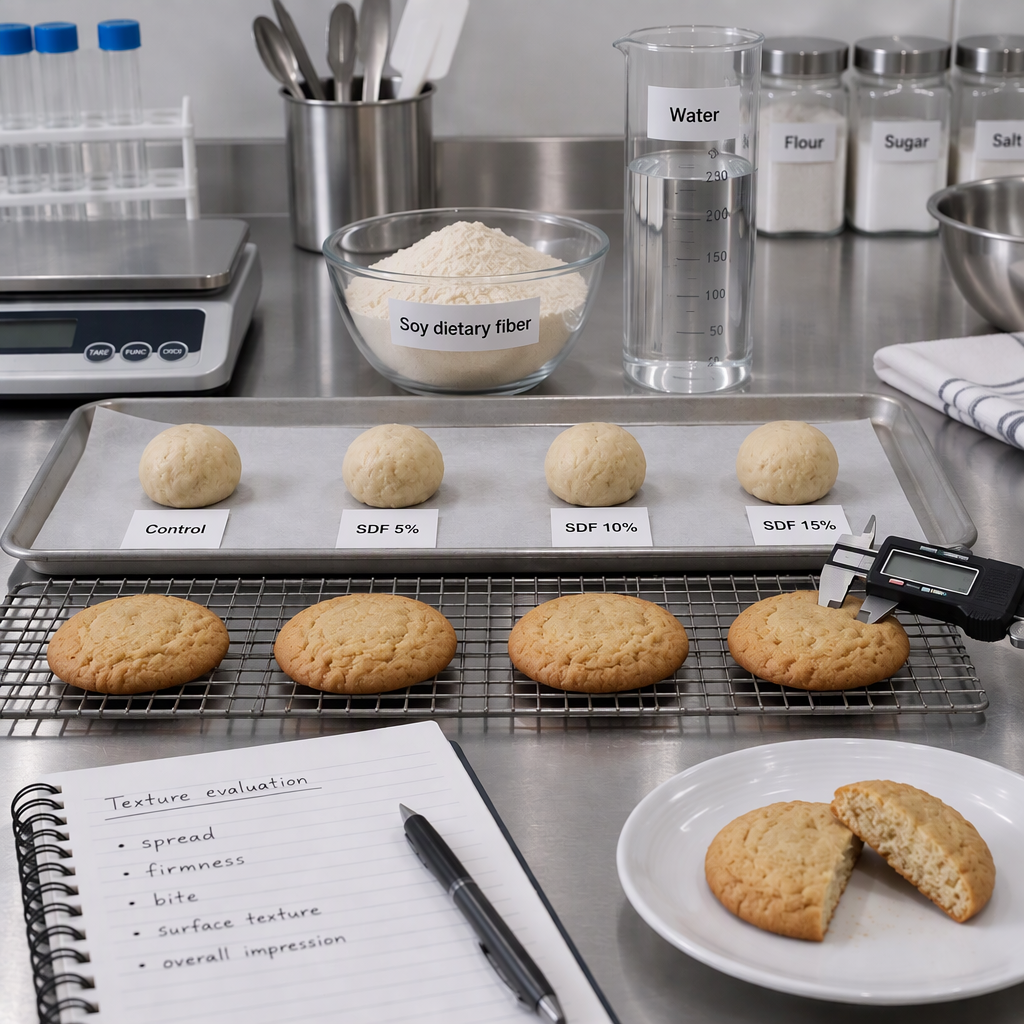
In a cookie study using residues from enzyme-assisted aqueous extraction of soybeans, higher substitution changed hardness, chewiness, weight and thickness, and acceptance was observed only within that study context.
The same study tested multiple substitution levels in cookies and evaluated dough texture, cookie texture, physical properties, digestibility and sensory acceptance. For bakery teams, the practical lesson is to watch the full product experience, not only water uptake.
| Trial watchpoint | Why it matters for selection | Buyer action |
|---|---|---|
| Hardness and chewiness | The study reported that texture attributes changed as soy-derived residue substitution increased. | Set an acceptable texture range against your current product or target benchmark. |
| Thickness, diameter or spread | Physical cookie properties such as weight and thickness were part of the measured response. | Measure geometry after baking rather than judging shape by eye alone. |
| Dough handling | The cookie work evaluated dough texture as part of the application study. | Record stickiness, cracking, sheeting, depositing or forming behavior using the same operator procedure for each sample. |
| Sensory fit | The application study included sensory acceptance alongside physical and texture testing. | Keep a small sensory panel or internal tasting step before moving to plant trials. |
Trial design: build a small matrix before changing plant formulas
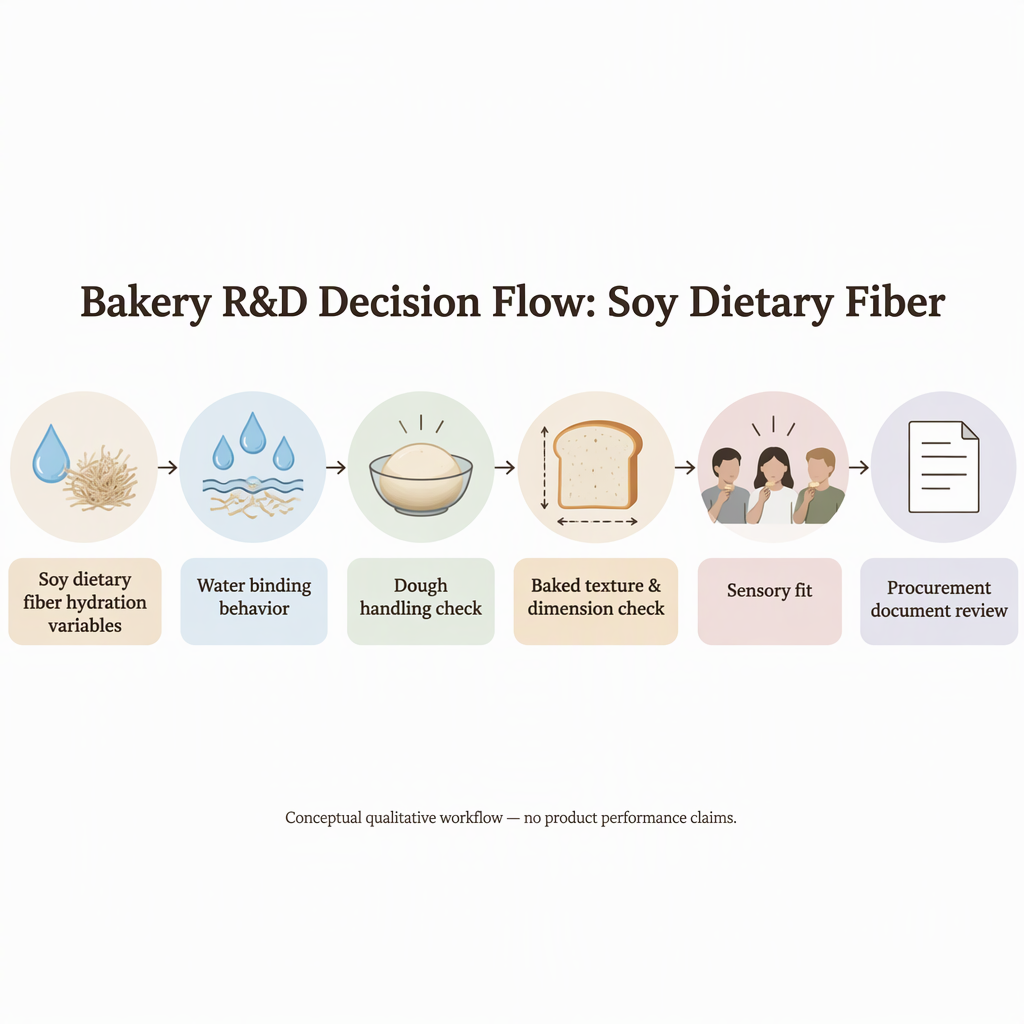
Start with a control formula and several incremental soy dietary fiber test levels, then compare dough handling, baked dimensions, instrumental or structured texture observations and sensory fit before plant-scale change.
- Define the control formula, target product attributes and process conditions before adding soy dietary fiber.
- Choose small, staged inclusion levels rather than jumping directly to a high replacement level.
- Hold mixing, resting, baking and cooling conditions constant across samples.
- Run replicates where feasible, because the published cookie study used triplicate experiments and statistical comparison.
- Record both operator handling notes and measured product results, then decide which level deserves a larger pilot run.
| Trial element | Suggested bench record | Decision use |
|---|---|---|
| Control | Current formula with no added soy dietary fiber | Shows whether any change is meaningful against the baseline. |
| Incremental fiber samples | The cookie study compared several replacement levels, including a no-replacement control. | Helps identify the point where water behavior and texture stop matching the target. |
| Measured texture and dimensions | The study used texture analysis and measured cookie diameter, thickness and weight. | Reduces reliance on memory or operator impression. |
| Repeatability | Replicate testing and statistical comparison were used in the published method. | Separates a promising result from one-off batch variation. |
For method discipline, the Scientific Reports cookie study measured dough and cookie texture, cookie dimensions and weight, and used planned statistical comparison. Your plant does not need to copy that study exactly, but it should define measurements before the trial starts.
More useful measures than operator impression include dough texture notes taken under one procedure, baked weight, diameter or thickness, texture readings where equipment is available, replicate sample results and a written sensory decision.
Go/no-go criteria: connect water, dough handling and finished texture
Continue only when the soy dietary fiber level supports acceptable dough handling and finished texture together; stop or adjust when water absorption comes with excessive hardness, chewiness shift, shape change or sensory decline.
- Go forward when the dough can be mixed, formed and baked under the intended process without special handling that the plant cannot repeat.
- Adjust the water or inclusion level if texture trends toward excessive hardness or chewiness compared with the target product.
- Check spread, thickness or weight changes before assuming the fiber level is commercially workable.
- Keep sensory acceptance in the decision, because the published cookie work evaluated sensory response as part of the application result.
- Hold supplier approval until the same result can be repeated with the ingredient lot and process conditions expected in production.
Do not convert the study acceptance level into a universal dosage recommendation. The result came from a specific cookie formula and a specific soy-derived residue, so your acceptable level must come from your own formula trial.
Procurement checklist: what to request before supplier approval
Procurement should approve a soy dietary fiber supplier only after R&D confirms the formula result and the supplier provides current documents that match the purchased grade.
- Current product specification sheet for the exact grade being quoted.
- Ingredient identity, source material description, particle-size information and recommended storage conditions.
- Typical water-binding or hydration guidance, clearly marked as supplier data rather than a plant guarantee.
- Lot-to-lot quality documents that your internal quality system requires.
- Application support notes for bakery use, if the supplier offers them.
- Regulatory and labeling documents for each target sales market, reviewed by your own regulatory specialist.
- Bench-trial report showing formula water, handling notes, baked dimensions, texture observations and sensory decision.
For any supplier, including 冠县瑞昌贸易有限公司, buyer approval should be based on the exact grade, documents and trial result you will use commercially. Do not approve a substitute grade only because it shares the same general ingredient name.
Supplier data limits: what to confirm before approval
Keep supplier claims narrow until the exact product documents and your own bakery trial support them.
- Use soybean-residue dietary fiber water-binding concepts to choose variables for testing, not to claim a fixed commercial value.
- Use the cookie study as a reminder that soy-derived fiber can change texture and acceptance, not as a universal recipe dosage.
- Use structured measurements, repeat samples and written comparisons before moving from bench to pilot scale.
- Ask the supplier for current grade-specific proof before making label, specification, certification or performance claims in purchasing documents.
Conclusion
The strongest selection path is to connect soy dietary fiber water behavior with dough handling and finished-product texture, then approve only the grade that performs consistently in your own bakery formula.
A disciplined bench matrix, repeatable measurements and a clear procurement document checklist help R&D and purchasing make the same decision from the same facts.
FAQs about soy dietary fiber in bakery trials
These questions help bakery R&D and purchasing teams turn bench results into a practical supplier decision.
What is soy dietary fiber used for in bakery development?
It is evaluated for its ability to interact with water and influence food texture applications, including bakery products. In selection work, that means checking water behavior together with dough handling and finished eating quality.
Can I use one published cookie study as my dosage guide?
No. The cookie study shows that soy-derived residue substitution can change hardness, chewiness and acceptance in that formula, but it does not set a universal dosage for other bakery systems.
Which trial result should decide whether to continue?
Use a combined decision: acceptable dough handling, acceptable baked dimensions, target texture and sensory fit. A high water uptake result alone is not enough if the product becomes too hard, fragile or difficult to process.
Do pH and temperature matter when testing water binding?
Yes. The soybean-residue dietary fiber review record identifies extrinsic conditions such as pH and temperature as factors affecting water-holding capacity, so keep them controlled when comparing samples.
What measurements should a small bakery trial include?
Useful records include dough texture observations, finished-product dimensions, weight, texture readings where available, replicate results and a planned comparison method.
Can procurement approve a supplier before R&D finishes the trial?
Procurement can collect documents early, but approval should wait until the exact grade has passed the formula trial and the supplier documents match the product being purchased.
Does soy dietary fiber automatically qualify for fiber labeling?
Do not assume automatic label eligibility. Ask for market-specific regulatory documents and have your regulatory specialist confirm the rule for each country or region where the bakery product will be sold.