English
 简体中文



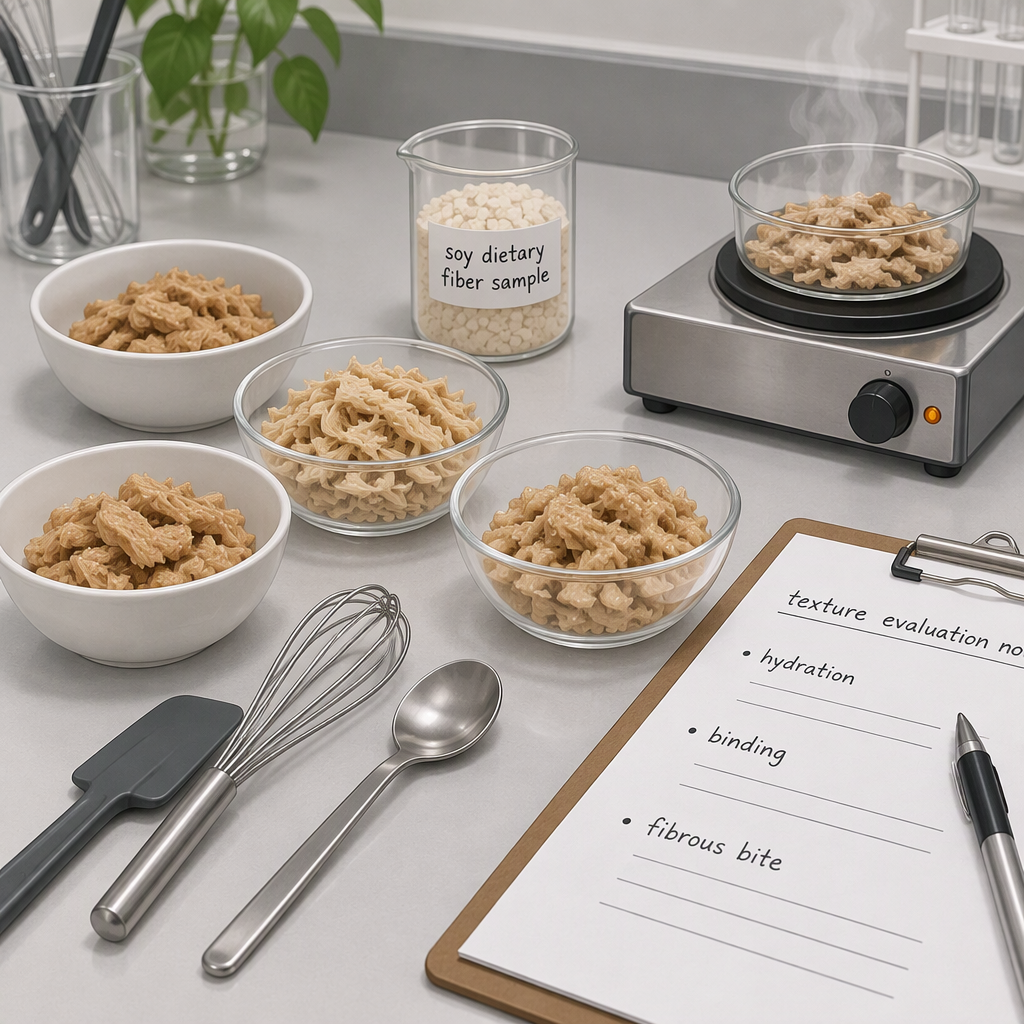
Before reformulating meat alternatives with soy dietary fiber, evaluate it as an application ingredient: test water uptake, water holding, water release, binding behavior, texture and heating response in the actual plant-based matrix, rather than assuming that fiber will behave like soy protein or prove a finished-product health benefit.
Start with what soy dietary fiber is—and is not
For reformulation work, treat soy dietary fiber as a candidate for water-management and texture-related trials, not as a drop-in substitute for the protein system that forms the main structure of many meat alternatives.
Water behavior in plant-based meat analogues is linked to structure, processing conditions and formulation environment, so an ingredient name alone does not predict finished-product juiciness, bite or cooking loss.
Research on soybean hull dietary fiber can provide useful formulation background, but findings from pork myofibrillar protein gel systems should be used as context for trial design, not as direct proof that the same effect will appear in a plant-based meat alternative.
That distinction matters for procurement as much as R&D. A supplier sample may be worth screening, but approval should depend on bench and pilot results in the target burger, mince, nugget, sausage or filling format.
Evaluate water holding and water release before changing dosage
Start with paired measurements: how much water the formula takes up, how much it retains before and after processing, and how much it releases during heating, holding and eating.
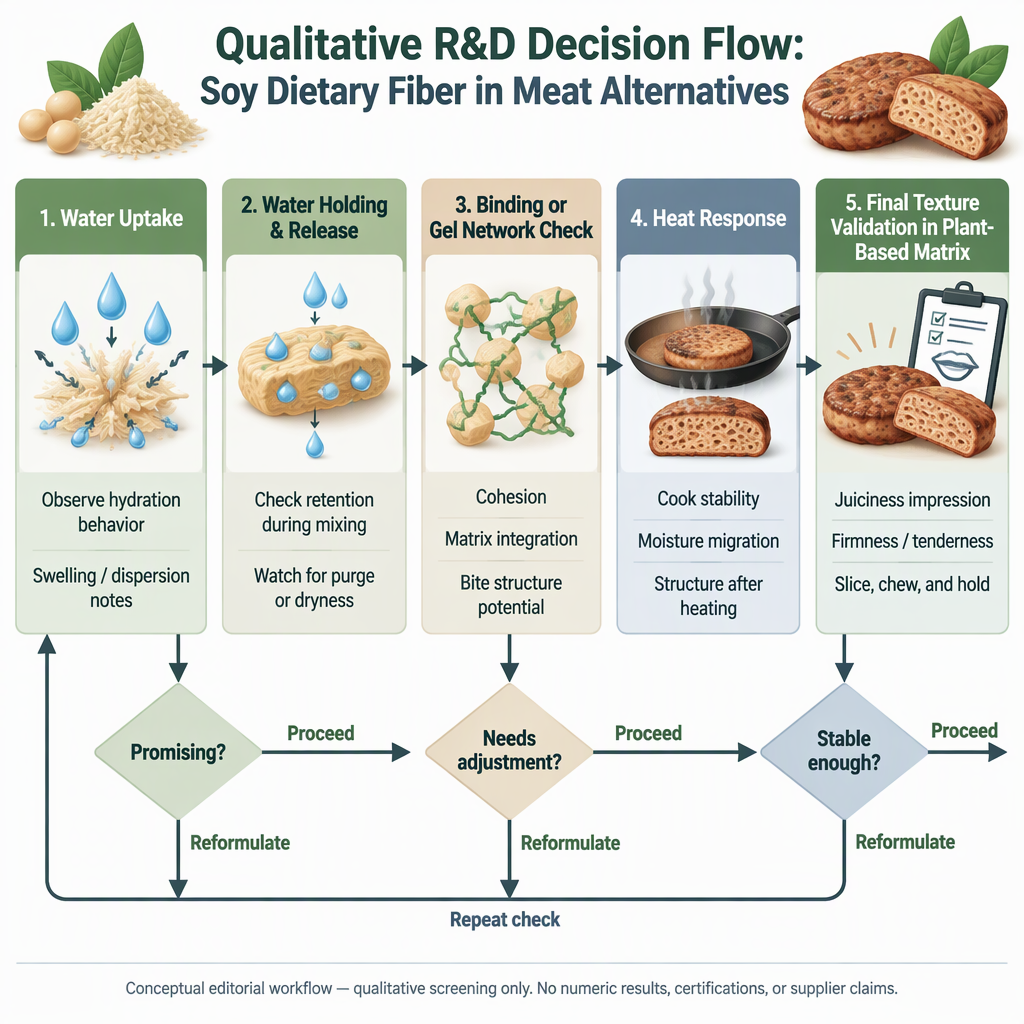
Wageningen University & Research work on plant-based meat analogues connects water holding, water uptake and water release with structure, processing, pH, ionic strength, cross-link density and perceived juiciness questions.
| Evaluation question | What to check before dosage change | Buyer decision it informs |
|---|---|---|
| Does the matrix absorb added water consistently? | Compare hydration behavior under the mixing order, shear and rest time used in the target process. | Whether soy dietary fiber can enter the next formulation round. |
| Does retained water stay in the product after forming and heating? | Measure water release or cooking loss alongside visual appearance and bite. | Whether a dosage improves yield perception without creating a wet or leaky product. |
| Does the water-management result survive process variation? | Screen pH, salt or ionic strength and heating conditions relevant to the actual recipe. | Whether the ingredient is robust enough for pilot production. |
A high water-holding number is not automatically a better eating experience. Plant-based meat analogue research treats water binding and release as structure-process-property questions, so R&D should evaluate retention together with sensory texture and juiciness targets.
Check binding, gel network and heat response in your matrix
Use soy hull dietary fiber research to shape binding and heat-response questions, then confirm every result in your own plant-based protein, starch, oil and water system.
- Screen the fiber in a base matrix and compare gel or binding behavior against the current control formula.
- Heat the trial samples under the intended product conditions and record firmness, cohesion and water release together, not as separate pass-fail items.
- Review whether the network becomes stronger, brittle, pasty, dry or unstable at the dosage being considered.
- Repeat the most promising condition in the real processing sequence because plant-based meat analogue water behavior depends on structure and process history.
A Frontiers in Nutrition study reported that a compound dietary fiber system including soybean hull dietary fiber affected pork myofibrillar protein gels, including water holding capacity, gel strength, storage modulus, secondary structure, chemical forces and microstructure under the study conditions.
For a plant-based meat buyer, the practical use of that finding is not to copy the result, but to include gel network, heat response and microstructure-related observations in the trial plan.
Screen texture and sensory trade-offs beyond WHC
A soy dietary fiber trial should pass texture and eating-quality checks, not only a water-holding capacity target.
- Check whether retained water supports juiciness or creates a soft, swollen or pasty bite.
- Compare raw handling, forming stability, cooked firmness and bite resilience in the same trial series.
- Observe water release after heating and short holding, because release behavior can affect perceived juiciness and product appearance.
- Track whether added fiber changes network cohesion or gel strength in a way that helps the target texture or makes it too rigid.
- Test the ingredient inside the intended product format rather than relying only on a hydrated powder or simple slurry.
The best reformulation signal is a balanced result: manageable hydration, stable processing, acceptable bite and controlled release during cooking and eating.
Build a reformulation trial plan for R&D and procurement
Procurement should request enough technical information and sample material to let R&D test soy dietary fiber in the target matrix before commercial approval.
- Define the target product format, process sequence and water-management problem before requesting samples.
- Ask suppliers for ingredient identity, recommended handling guidance and quality documents applicable to the buyer’s market and product category.
- Run a control formula, a low-dose trial and a higher-dose trial only within safe and practical formulation limits set by the R&D team.
- Measure water uptake, retained water, release after heating and texture in the same test set.
- Include binding or gel-network observations where the product depends on cohesion, sliceability or bite.
- Do not approve the ingredient from a single bench result; repeat promising conditions in the intended processing sequence.
| Trial outcome | Procurement action | R&D action |
|---|---|---|
| Water retention improves but cooked bite becomes soft | Keep the supplier sample open for limited trials only. | Adjust the matrix and retest texture, not only dosage. |
| Water release remains high after heating | Request additional handling or application guidance from the supplier. | Review hydration order, process conditions and matrix compatibility. |
| Binding or gel behavior changes under heating | Do not convert the sample to approved status yet. | Confirm whether the change supports or harms the target product texture. |
Conclusion
Select soy dietary fiber for meat alternatives only after it performs in the buyer’s actual water, protein, oil, process and heating system.
- Water holding and water release should be evaluated together.
- Soybean hull dietary fiber research can inform gel and binding questions, but plant-based validation is still required.
- Do not treat fiber identity as proof of finished-product texture, juiciness, health benefit or supplier performance.
FAQs about soy dietary fiber in meat alternatives
These questions help R&D and procurement decide whether a soy dietary fiber sample deserves further plant-based meat testing.
Is soy dietary fiber a protein replacement in meat alternatives?
No. For application selection, evaluate it for water-management and texture effects, while keeping protein structuring decisions separate.
What should be tested first: water uptake or cooked release?
Test both. Water uptake shows how the matrix hydrates, while cooked release shows whether that water remains controlled during heating and holding.
Can water holding capacity alone approve an ingredient?
No. Water holding should be reviewed with process stability, cooked texture, release behavior and perceived juiciness.
How should soybean hull dietary fiber research be used?
Use it to design questions about gel strength, binding, heat response and microstructure, then validate the result in the plant-based formula.
What should procurement request before buying trial material?
Request clear ingredient identity, handling guidance, applicable quality documents and enough sample material for controlled bench and pilot comparison.
Does adding soy dietary fiber prove a health benefit in the finished meat alternative?
No. This reformulation decision should focus on application performance unless the buyer has separate, current regulatory and nutrition evidence for the intended claim.
When should a sample be rejected or paused?
Pause the sample when it improves one metric but creates unacceptable water release, soft bite, processing instability or heating performance in the target product.