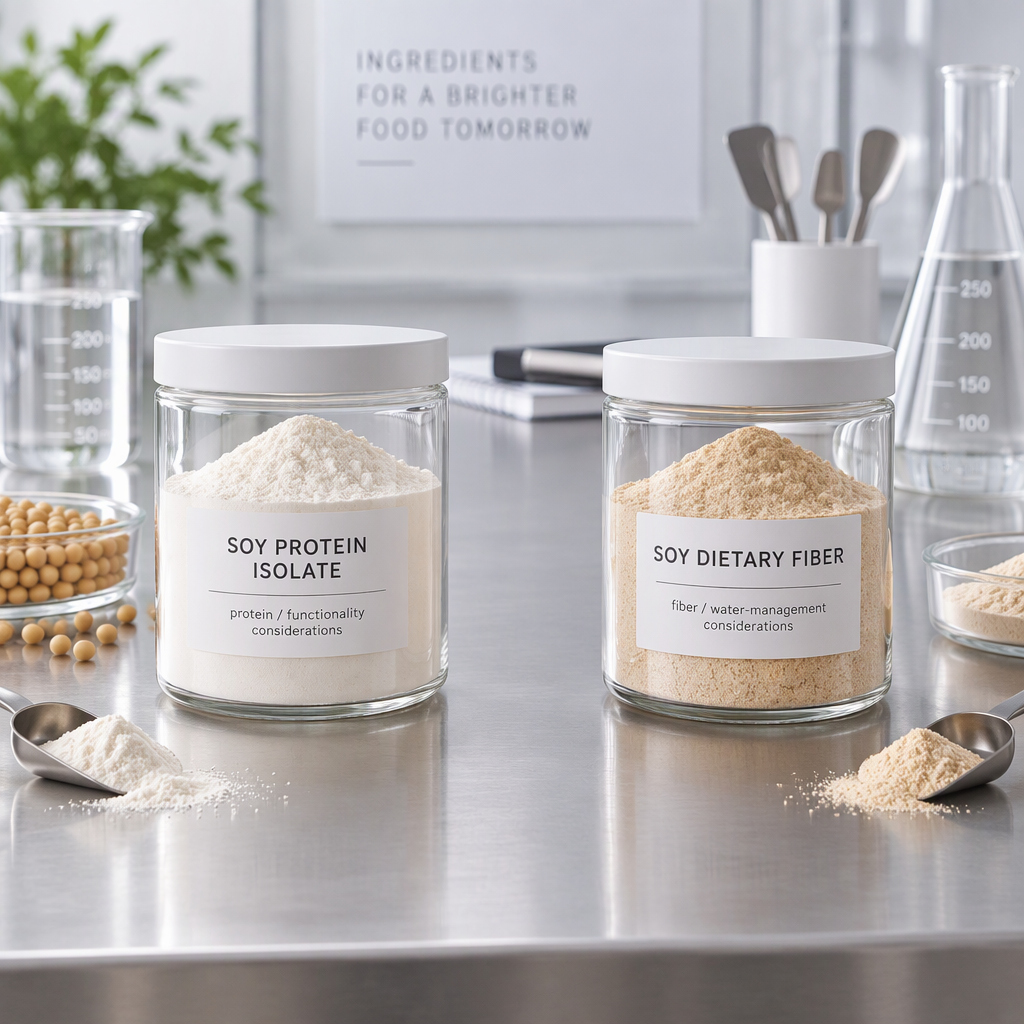
For food R&D and ingredient procurement, treat soy protein isolate vs soy dietary fiber as a formulation-role decision, not a naming variation: soy protein isolate is selected for protein content and protein-driven functions, while dietary fiber status depends on fiber identity and labeling rules and soy-derived fiber may be evaluated for water-management and texture roles.
What is the practical difference between soy protein isolate and soy dietary fiber?
Soy protein isolate and soy dietary fiber should be specified as different ingredient categories because they solve different formulation problems.
Soy protein isolate
The U.S. Soybean Export Council describes soy protein isolate as a specialty soy ingredient for human food formulations and states that soy protein isolate is at least 90% protein on a moisture-free basis, commonly supplied as a dry powder.
Its relevant formulation functions include solubility, gelation, hydration, emulsification, adhesion/cohesion, and foaming.
Soy dietary fiber
For U.S. Nutrition and Supplement Facts labeling, FDA’s Federal Register notice defines dietary fiber around non-digestible soluble and insoluble carbohydrates, lignin intrinsic and intact in plants, and certain isolated or synthetic non-digestible carbohydrates with beneficial physiological effects.
A FAO AGRIS record on soybean residue dietary fiber describes okara as rich in dietary fiber, predominantly insoluble, and discusses water-holding, absorption, retention, adsorption, cross-linking, and food texture considerations.
Which formulation job fits soy protein isolate?
Choose soy protein isolate when the project needs a protein ingredient and the formulation depends on protein-related functionality such as solubility, gelation, hydration, emulsification, adhesion/cohesion, or foaming.
For category-level verification, the U.S. Soybean Export Council specialty soy page describes soy protein isolate as a high-protein specialty soy ingredient and lists the functional properties associated with specialty protein ingredients.
Use soy protein isolate on the RFQ when protein level is a primary composition target.
Ask the supplier to state the tested protein basis, because moisture-free-basis language and as-supplied values are not the same purchasing statement.
Request application-relevant functional tests when the food system depends on emulsification, gelation, hydration, foaming, or related protein behavior.
Do not assume that a fiber ingredient can deliver the same protein-driven function without reformulation trials.
Which formulation job fits soy dietary fiber?
Choose soy dietary fiber when the project is built around fiber identity, water management, texture contribution, or a fiber-related labeling target rather than protein enrichment.
The FAO AGRIS record on soybean residue dietary fibers discusses soybean residue, or okara, as predominantly insoluble dietary fiber and connects water-holding capacity with food texture optimization.
For procurement, that means the RFQ should not simply ask for “soy ingredient.” It should state whether the formula needs a protein isolate or a dietary fiber, then request the corresponding composition and performance evidence.
How should R&D compare specifications and tests before purchasing?
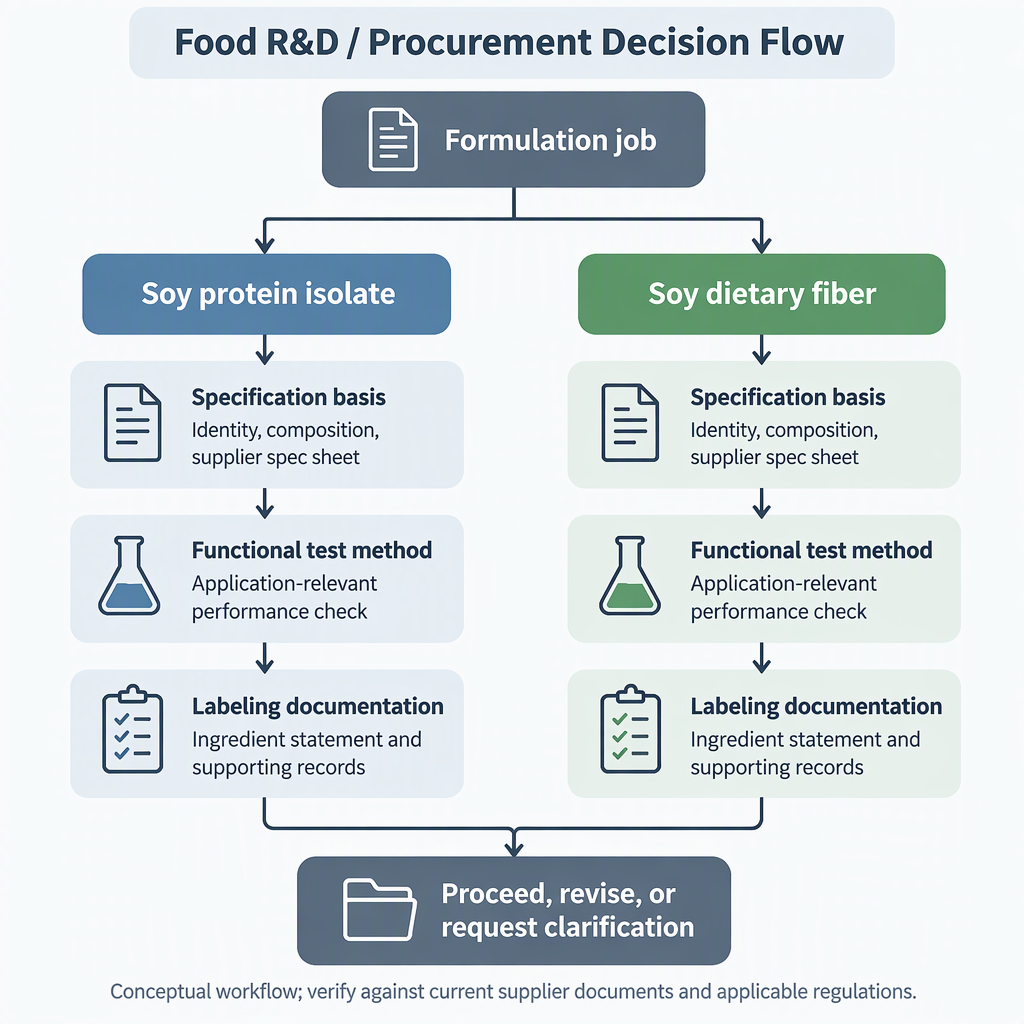
Compare the intended formulation job first, then match the specification and test package to that job before accepting a quote.
Buying question
Soy protein isolate
Soy dietary fiber
Primary formulation purpose
Protein enrichment and protein-driven functions such as solubility, gelation, hydration, emulsification, adhesion/cohesion, and foaming.
Fiber-related texture and water-management evaluation, especially where soybean-residue dietary fiber is relevant.
Composition evidence to request
Protein value and basis of reporting, including whether the supplier reports on a moisture-free basis or as supplied.
Fiber identity and documentation suitable for the target market’s dietary fiber treatment.
Functional tests to request
Application-relevant protein-function tests, such as emulsification, hydration, gelation, foaming, or solubility methods when those functions drive the formula.
Water-holding, water absorption, water retention, adsorption, or texture-related tests when those are critical to the finished food.
Interchangeability risk
Do not substitute for a fiber ingredient solely because both are soy-derived.
Do not substitute for a protein isolate when the formulation requires protein level or protein-driven functionality.
State the food application and the exact job the ingredient must perform.
For soy protein isolate, request protein basis and functional test methods relevant to the application.
For soy dietary fiber, request fiber source, water-management test methods, and texture evaluation data where applicable.
For label claims, request documentation that matches the destination market instead of relying on the ingredient name alone.
Where do labeling and claim checks create a boundary?
A soy fiber ingredient should not be treated as automatically label-ready dietary fiber; the labeling decision depends on the applicable market definition and supporting documentation.
Decision point
Buyer action
Why it matters
Destination market
Confirm the rule set for the country or region where the product will be sold.
The cited FDA notice supports a U.S. labeling boundary, not a global regulatory equivalence claim.
Fiber identity
Ask whether the fiber is intrinsic and intact, isolated, synthetic, or otherwise documented for the claim.
FDA’s notice distinguishes types of non-digestible carbohydrates for dietary fiber treatment.
Claim wording
Separate nutrition-label treatment from marketing language and get regulatory review before final artwork.
Ingredient purchasing evidence is not a substitute for finished-label approval.
Procurement checklist to avoid ingredient confusion
A clear RFQ should name the ingredient category, define the formulation job, and request tests that match either protein functionality or fiber functionality.
Write the ingredient category explicitly: soy protein isolate or soy dietary fiber.
State the food application, such as meat analogue, beverage, bakery, dairy-type product, or other target system, without assuming one ingredient suits all systems.
If requesting soy protein isolate, ask for protein basis and application-relevant functional data for the needed protein behavior.
If requesting soy dietary fiber, ask for fiber source and water-management or texture-related testing where that drives the formulation.
If a dietary fiber claim is planned, ask for labeling documentation suitable for the destination market.
Keep price, lead time, certifications, and capacity as separate supplier-qualification checks; do not infer them from category descriptions.
Require a sample and pilot trial before approving a substitution between the two categories.
Conclusion
The safest selection rule is simple: buy soy protein isolate for protein-driven formulation work and buy soy dietary fiber for fiber-driven formulation work, then verify the exact specification and tests before purchase.
Soy protein isolate is a high-protein specialty soy ingredient with protein-related functionality.
Soy-derived dietary fiber discussions may center on water-holding and texture, but the evidence should match the specific fiber source.
Dietary fiber labeling requires market-specific documentation, especially for U.S. Nutrition and Supplement Facts treatment.
FAQs
These buyer questions help R&D and procurement keep ingredient identity, function, tests, and labeling in separate decision lanes.
Can soy protein isolate replace soy dietary fiber, or can soy dietary fiber replace soy protein isolate?
Not without reformulation and testing. Soy protein isolate is tied to protein content and protein functionality, while soybean-residue dietary fiber evidence focuses on fiber and water-management behavior.
Is soy protein isolate mainly selected for protein content?
Protein content is a central reason to specify soy protein isolate, and the category is also associated with functional properties such as solubility, gelation, hydration, emulsification, adhesion/cohesion, and foaming.
Is water-holding capacity the only test that matters for soy dietary fiber?
No. Water-holding capacity is important in the soybean-residue dietary fiber record, but buyers may also need water absorption, water retention, adsorption, cross-linking, and application texture data depending on the food system.
Does a soy fiber ingredient automatically qualify as dietary fiber on a label?
No. For U.S. Nutrition and Supplement Facts labeling, FDA’s notice ties dietary fiber treatment to the type of non-digestible carbohydrate, whether it is intrinsic and intact or otherwise recognized, and beneficial physiological effect determinations for certain isolated or synthetic carbohydrates.
What should an RFQ say to avoid confusing the two ingredients?
It should name the ingredient category, application, target function, composition requirement, and test method. Protein-function tests are relevant to soy protein isolate selection, while water-management and texture tests are relevant to soy-derived dietary fiber evaluation.
Can one U.S. dietary fiber reference be used for every global market?
No. The cited FDA notice supports a U.S. labeling discussion, so buyers should confirm the applicable rule set and documentation requirements for each destination market.
What supplier documents are most useful before approval?
Ask for a current technical data sheet, certificate of analysis, test methods, sample lot information, and any market-specific labeling support. Keep these requests separate from unverified claims about certifications, lead times, capacity, or commercial performance.
 English
 简体中文