Views: 0 Author: Site Editor Publish Time: 2026-08-29 Origin: Site


The plant-based food market is growing fast. Consumers now want sustainable options that match their values. This growth pushes food manufacturers to innovate quickly. You need ingredients that work well under production conditions.
Plant protein comes in three technical forms. Concentrates contain 60-80% protein. Isolates, like Xinrui Group's Soy Protein Isolate, give at least 90% protein on a dry basis. Flours keep more carbohydrates and fiber.
This guide helps R&D, procurement, and production teams. It offers practical ways to pick ingredients. How do you choose the right plant-based protein for your product matrix, budget, and rules? Knowing functionality, sourcing, and compliance helps you decide with confidence. Plant-based proteins differ in solubility, emulsification, and texture-building ability. Your choice affects final product quality and cost. Plant-based products must also meet labeling rules. The plant-based diet trend drives demand for clean-label ingredients. Plant-based foods need steady supply chains. Think about the environmental footprint of your sourcing. These factors shape successful formulation plans.
Plant proteins come in three types: flours, concentrates, and isolates. Isolates contain the most protein.
Pick the protein source that fits your product's needs. Soy isolate is good for texture and emulsification.
Learn about the ways to extract protein. Wet fractionation makes a purer product, while dry fractionation keeps the protein in its natural form.
Control bad tastes and textures. Use processing methods and flavor covers to make food taste and feel better.
Make sure your supply chain is dependable and follows the rules. Think about cost, eco-friendliness, and what you put on labels.
Plant protein comes from seeds, grains, and legumes. These plant-based proteins give you the raw material for your products. You process these sources into powders with different protein levels. The three main categories form the foundation of your ingredient choices. Understanding these categories helps you pick the right ingredient for your product.
Flours are the simplest form of plant-based protein. You grind the whole seed or grain into a powder. Flours keep most of the original carbohydrates, fiber, and fats. They contain the lowest protein percentage among the three categories. You might use flour in baked goods or as a base ingredient.
Concentrates and isolates go through more processing. They remove non-protein components like starch and fiber. The table below shows the protein content thresholds for each category.
Category | Protein Content Threshold |
|---|---|
Protein Concentrates | 60% – 80% |
Protein Isolates | >80% |
Flours | Not specified in standard definitions |
Isolates deliver the highest purity among plant protein sources. Soy protein isolate contains 90% protein on a moisture-free basis. The isoelectric precipitation process recovers 75% of the protein from the starting defatted soybean material. This high yield makes isolates efficient for manufacturers who need maximum protein content.
The processing method affects more than just protein content. It changes the molecular structure of the proteins. A comparison between walnut protein concentrate and walnut protein isolate shows clear differences. The concentrate has a complex molecular weight distribution with protein aggregation. The isolate has a uniform distribution. The concentrate also has significantly higher surface hydrophobicity. These structural differences lead to different functional properties. The isolate generally performs better. It has higher fat absorption capacity and better emulsifying and foaming properties at alkaline pH. The concentrate has a more compact, small flaky structure. The isolate has big flaky plate-like structures.
When you choose a plant-based protein source, consider these differences. You might need a plant-based protein powder for a beverage. In that case, an isolate with high solubility works best. For a baked good, a concentrate might provide enough function at a lower cost. Your choice of protein sources affects the final product texture, stability, and cost. These are the main sources of protein you will work with in product development.
You can separate plant proteins using two main methods. Each method affects the final product differently. The choice between them depends on your product goals.
Aspect | Dry Fractionation | |
|---|---|---|
Energy consumption | High energy consumption is a known limitation | Based on mechanical separation, implying lower energy input |
Water usage | Associated with environmental pollution and large solvent use | No water or solvents used |
Protein purity | Higher purity potential | Lower purity due to residual proteins in starch fractions |
Wet fractionation uses liquids like water, acids, or alkalis. This method can achieve higher purity. But it consumes more energy and water. It can also cause some protein damage. Alkaline extraction, for example, can reduce digestibility and create bitter flavors. You might notice this in some plant-based protein powders.
Dry fractionation uses mechanical separation. You mill the material and use air classification to separate protein from starch. This method preserves the native structure of the proteins better. It uses no water or solvents. However, the purity is lower. You get a product with more fiber and starch remaining.
For pea protein production, the choice matters. Dry fractionation achieves about 50% protein purity. It preserves the native structure well. This gives higher solubility and stronger gel properties. The gel strength at pH 7 is nearly double. Wet fractionation can reach about 80% purity for isolates. It offers enhanced solubility, improved emulsification, and superior foaming properties. The alkaline extraction-isoelectric precipitation method is the industrial standard but causes denaturation.
Your choice depends on your application. If you need high purity for a clear beverage, wet fractionation is better. If you want to preserve native functionality for a gel product, dry fractionation might work. Working with plant-based proteins requires understanding these methods. Both plant-based proteins have their place in product development. This knowledge supports your goals in plant-based nutrition.
Picking the right plant protein sources helps decide how well your product does. Each source brings its own nutrition and function. Knowing these differences helps you match ingredients to your needs. The table below shows the main protein sources you will see.
Protein Source | Protein Content (g/100g) | PDCAAS | DIAAS | Key Limitation |
|---|---|---|---|---|
Soy protein isolate | 88.3 | 1.00 | 0.90 | None (highest rated plant protein) |
Pea protein isolate | 80.0 | 0.89 | 0.82 | Slightly low in methionine |
Rice protein concentrate | 78.0 | 0.47 | 0.59 | Limited by lysine |
Faba bean protein | 80.0 | Not specified | Not specified | Not specified as complete protein |
Lentils (cooked) | 9.0 | 0.71 | 0.63 | Limited by methionine, lower digestibility |
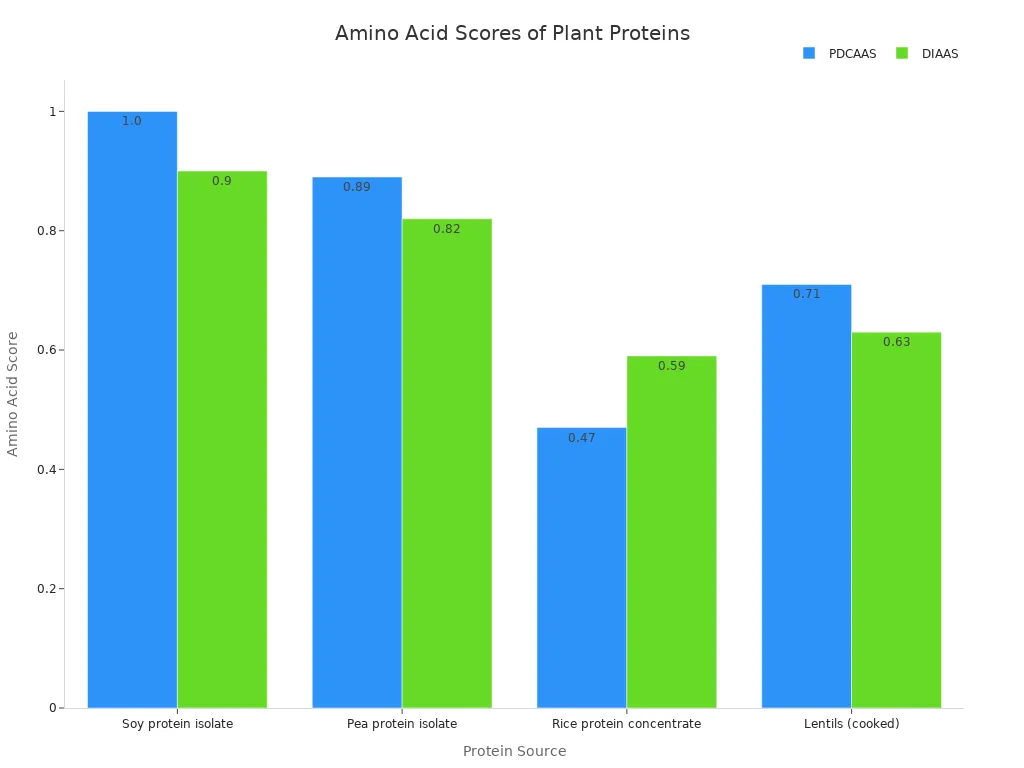
Soy protein isolate leads the market for good reason. It gives a full amino acid profile with the top PDCAAS score of 1.00. This plant-based protein forms fibrous structures at high temperatures around 160°C. You can use it in meat analogs through high-moisture extrusion. Many makers blend it with wheat, pea, corn, mung bean, or peanut proteins to boost texture. Soy also does well in dairy alternatives, drinks, bakery items, and extruded snacks. Its emulsifying traits improve mouthfeel. Its gelling ability adds structure. Its water holding capacity helps moisture and shelf life. Unlike wheat protein, soy avoids gluten sensitivity issues. Compared to pea or mung bean proteins, soy makes stronger gels and better texture.
Pea protein isolate offers a solid choice with 80% protein content. Its PDCAAS of 0.89 makes it nutritionally solid. Pea protein works well in meat analogs and protein drinks. It has a neutral flavor that consumers like. But it has slightly low methionine levels. You may need to mix pea with other protein sources to balance amino acids.
Rice protein concentrate gives a hypoallergenic option. Its lysine limit drops its PDCAAS to 0.47. Rice protein works best when mixed with other plant-based proteins. This mix fills its amino acid gaps.
Faba bean protein matches pea's protein content at 80%. This new source shows promise for sustainable production. Faba beans grow well in cooler climates. They fix nitrogen in soil, cutting fertilizer needs. This environmental benefit draws makers looking for sustainable ingredients. Faba bean protein works well in meat analogs and bakery products.
Lentils offer a different profile. Cooked lentils have only 9% protein. Their PDCAAS of 0.71 shows methionine limits and lower digestibility. But lentil flour gives excellent thickening properties. You might use it in soups, stews, or plant-based meat products where texture matters more than protein amount.
Canola protein comes as a byproduct of oil extraction. This plant protein source offers good function at low costs. Canola protein shows strong emulsifying properties. It works well in dressings, sauces, and dairy alternatives.
Your choice among these protein sources depends on your product goals. Think about nutrition targets, function needs, and cost limits. Each source brings clear strengths to your mix. The environmental impact of your sourcing also matters. Faba beans and lentils improve soil health. Soy production faces deforestation concerns in some areas. Weigh these factors carefully as you pick your ingredients.
Four key traits decide how plant proteins work in your products. Each protein source acts differently. Solubility controls how proteins reach surfaces. Emulsification keeps oil droplets mixed in water. Water and oil retention improves moisture and texture. Gelling builds the network structure for meat analogs. Each trait links to a specific use.
You must match protein traits to your product needs. Different sources offer different strengths. Knowing these differences helps you choose the right protein. The table below shows how newer sources work for meat analogs.
Protein Source | Functional Properties Relevant to Meat Analogues |
|---|---|
Lentils | Gelling capability comparable to whey proteins (highly pH dependent). Oil holding and foaming capacity comparable to soy. Excellent emulsifying characteristics and high gel strength. |
Faba beans | Heat treatment and low-moisture extrusion increase water holding capacity, water solubility, and gel strength. Fibrous layered structure possible with high-moisture extrusion. |
Chickpea | Low foaming capacity versus soy but high foam stability. Gelling ability similar to soy. High water and oil binding capacity beneficial for meat analogs. |
Most plant proteins need 10 to 18 percent concentration to form gels. Chickpea proteins can gel at just 5 to 7 percent. Studies show adding chickpea protein concentrate to sausages boosted gel strength. These differences matter when you design your formula. These protein sources give you choices for your product needs.
Xinrui Group's Soy Protein Isolate performs well across many uses. In sausages, it boosts moisture and oil retention. The protein binds water and fat, stopping purge during cooking. You get a juicier product with better texture. In meatballs, the isolate works as an emulsifier. It stabilizes the fat-in-water mix, giving you a smooth texture. In beverages, high solubility allows clean dispersion. You can use a plant-based protein powder in drinks where solubility matters most. You can add protein to drinks without sediment or gritty feel. In vegetarian foods, gelling properties create structure. The protein forms a network that holds the product together, giving you a meat-like bite.
The solubility of plant proteins depends on pH. You measure it by mixing protein in buffer, adjusting pH, spinning it down, and checking the liquid. Higher solubility means better emulsification and foaming.
High-moisture extrusion creates fibrous textures for plant-based meat. The process softens and melts proteins through heat, water, and mechanical force. You then align the proteins via smooth flow in a long cooling die. Key settings include moisture of 40 to 70 percent and barrel heat of 130 to 180 degrees Celsius. The cooling die creates a temperature drop, boosts shear flow, and promotes non-covalent bonds. These bonds form the fiber structure for meat analogs. Xinrui Group's Soy Protein Isolate handles this process well. Its high purity and steady molecular structure support fiber formation.
Texture and flavor are the biggest hurdles in plant-based product work. Consumers expect plant-based foods to match animal-based texture. You need to fix both to make a product people will buy again. Different protein sources need different processing methods.
Common off-flavors in plant proteins include beany, grassy, earthy, chalky, and bitter notes. These flavors come from volatile compounds like hexanal and pentanal made by lipoxygenase activity. The table below shows the sources and fixes.
Off-Flavor | Source / Cause | Mitigation Method |
|---|---|---|
Beany, grassy | Hexanal, pentanal from lipoxygenase activity | Controlled heat treatment at 70 to 90 degrees Celsius for 2 to 4 minutes to inactivate lipoxygenase |
Beany, vegetable-like | Enzymatic reactions during extraction | Specific grinding, water extraction, heating, pH adjustment, and shearing process |
Bitterness, astringency, green notes | Non-animal protein matrix | Compositions with yeast lysate, glucosylated steviol glycosides, and vanillin |
General off-flavor | Non-animal proteins | Ethyl cyclohexanoate as a selective flavor masking agent |
Flavor fade / off-flavor binding | Protein-flavor interaction | Protein-binding terpenes and carbonyl compounds |
You must fix both the main off-note and secondary notes that appear during processing and shelf life. The process has three steps: find the off-note source, check your product matrix including pH, heat, and shear conditions, and create targeted masking flavors. This knowledge helps you build better plant-based products.
Recent studies show that controlled enzymatic hydrolysis plus ultrasonic treatment can boost solubility and emulsifying activity of pea protein isolates. This creates emulsions with finer droplets and longer stability. New membrane-based separation of sunflower seed proteins gives isolates with great water-holding capacity and thermo-reversible gel strength. These proteins form elastic gels at low concentrations. These advances offer new ways to build plant-based meat analogs without synthetic additives.
Xinrui Group's Soy Protein Isolate starts with high-quality non-GMO soybeans. The processing methods keep the protein's native structure. This gives you a clean flavor that needs less masking. You can focus on building your product's signature taste rather than fighting off-flavors from the start.
Your plant protein supply chain faces many climate pressures. Climate change slows down how fast crops can grow. Extreme weather events disrupt harvest stability and crop yields. These disruptions directly affect food prices and availability. Geopolitical shocks add another layer of risk.
Critical maritime routes face significant disruption. The Strait of Hormuz serves as one of the world's most important corridors for fuel and fertilizer. Direct consequences for crop input costs and food production capacity ripple across global supply chains.
These factors create price differences between protein sources. Soy isolate costs about $2.52 per kilogram. Pea isolate from China costs $5.88 per kilogram before shipping. Premium pea isolate from US or European sources costs $7.88 to $8.88 per kilogram. Different protein sources carry various environmental costs. Understanding these costs helps you make informed sourcing decisions. Processing methods affect your overall environmental footprint.
Xinrui Group offers stability through 23 years of experience. The company exports 20,000 tons of isolated soy protein annually. This capacity supports reliable sourcing for global manufacturers. Non-GMO soybeans provide consistent quality. Long-term contracts with trusted suppliers help you lock in favorable pricing.
Labeling rules differ across markets. The United States allows terms like "burger" or "sausage" for plant-based foods if they do not imply animal origin. The United Kingdom prohibits terms like "milk," "yogurt," or "cheese" for plant-based products, including qualifiers like "style" or "type."
Allergen declarations require careful attention. Under FALCPA, major plant protein allergens include peanuts, soybeans, tree nuts, wheat, and sesame. You must declare these on packaging using one of two methods. First, include the common name followed by the food source in parentheses. Second, use a "Contains" statement after the ingredient list.
Non-GMO certification adds value for consumers following a plant-based diet. Xinrui Group's Soy Protein Isolate comes from non-GMO soybeans. This certification supports clean-label claims. It helps you meet consumer demand for transparency in sourcing.
Sustainability matters throughout your sourcing decisions. Choosing suppliers with sustainable production practices reduces your environmental impact. Plant-based proteins generally require fewer resources than animal sources. Faba beans and lentils improve soil health through nitrogen fixation. Evaluating sustainability across your entire supply chain helps you meet consumer expectations. Diverse protein sources give you flexibility against market shifts. Your environmental footprint depends on the sources you select. Environmental regulations continue to tighten across major markets. This environmental impact reduction supports your long-term sustainability goals. Staying current with these rules protects you from costly compliance issues.
Selecting the right plant-based protein means balancing functionality with cost. Different sources offer different strengths. No single source works for every application. You must test multiple sources through thorough trials. A reliable supply chain ensures consistent quality. Partnering with Xinrui Group gives you technical support.
The market for plant-based products is growing fast. The hydrolyzed vegetable protein market is projected to reach $3.7 billion by 2030. Plant-based proteins will capture 30% of the total protein market. A plant-based diet trend drives consumer demand. Mastering these fundamentals helps you build successful plant-based meat alternatives. Innovation in extrusion and fermentation improves meat analogs. Understanding these protein sources reduces environmental impact. Sustainability remains a key driver.
Soy isolate gives you 90% protein and a full set of amino acids. Pea concentrate offers 80% protein and a mild taste. Each source has its own strengths. Look at these options based on what your product needs.
Pick a protein that fits your product's needs. Soy isolate works great for mixing oil and water. Pea protein is a good fit for drinks. Test different proteins as you build your recipes. Trusted suppliers give you steady quality.
Non-GMO certification helps earn customer trust. It backs up your eco-friendly claims and lowers your environmental footprint. Xinrui Group provides non-GMO soy protein isolate. This helps you meet clean-label needs for your plant-based items.
Use plant proteins that form strong gels. Soy protein isolate creates fibrous structures during high-moisture extrusion. This gives you the chewy feel consumers want from plant-based foods.
Yes. Pick a plant-based protein powder that dissolves well. Soy protein isolate mixes in without leaving sediment. This gives you a smooth drink. Other protein sources also perform well in beverages.

 English
 简体中文
简体中文